




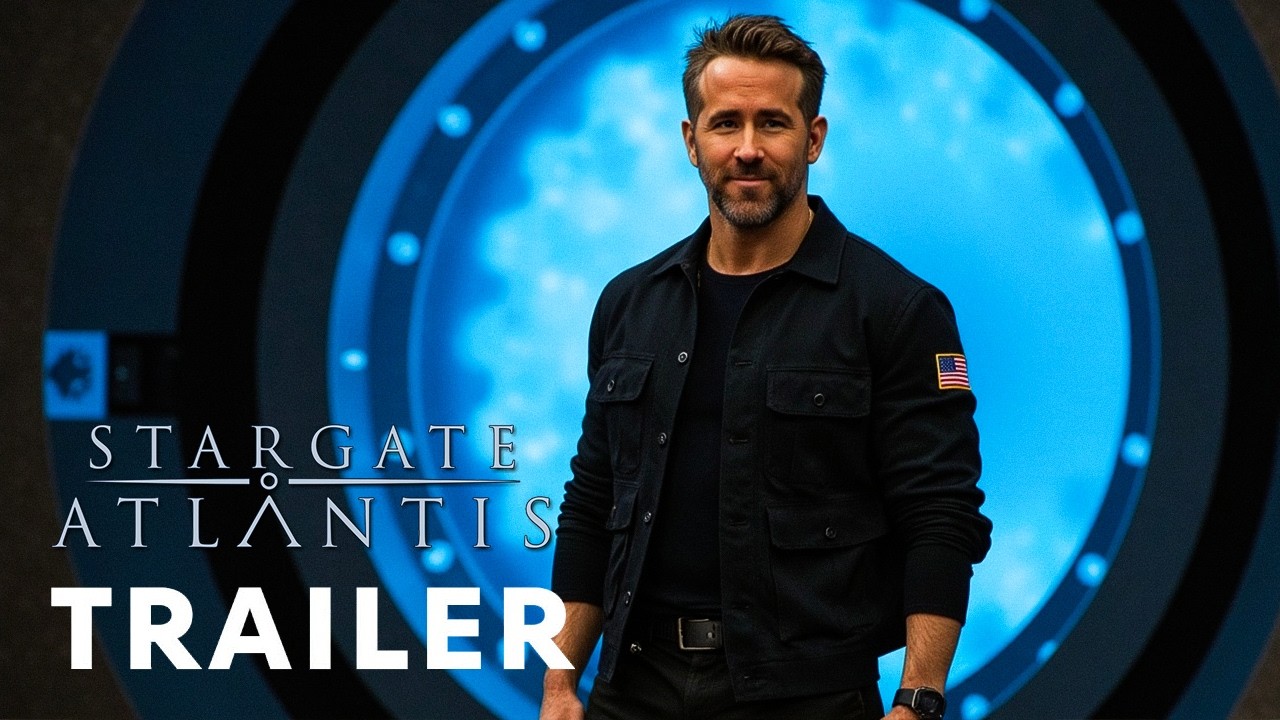
A Familiar Gate, Reopened with Purpose
There is a particular thrill in watching a long-dormant science fiction universe reassert its identity, not by reinventing itself beyond recognition, but by remembering exactly why it mattered in the first place. Stargate: Rise of Atlantis arrives with the confidence of a franchise that knows its history and respects its audience. This is not nostalgia for nostalgia’s sake. It is a continuation, shaped by time, experience, and a deeper understanding of what made Stargate Atlantis endure.

Set against the striking image of the city of Atlantis docked in San Francisco Bay, the film immediately establishes its central tension: the collision between cosmic destiny and earthly bureaucracy. The city has returned home, but home is not where Atlantis belongs. That dissonance drives the narrative forward with urgency and emotional weight.

The Story: When Survival Demands Rebellion
The premise is elegantly simple and dramatically potent. Atlantis, now a political prisoner under military and governmental scrutiny, sits vulnerable as a terrifying threat approaches. A Wraith Hive fleet races toward Earth, and for all of humanity’s technological progress, there is no defense capable of stopping it.

Faced with extinction, Colonel John Sheppard and his seasoned team reach a conclusion that feels both inevitable and morally complicated: the rules must be broken. What follows is a high-stakes act of defiance, as the crew plans to steal Atlantis itself and take the fight back to the stars. The film frames this not as reckless heroism, but as a painful necessity, one born from loyalty to humanity rather than allegiance to authority.
This narrative choice grounds the spectacle in character-driven stakes. The question is never simply whether they can succeed, but what it costs them to try.
Performances: A Reunion That Earns Its Emotion
The returning cast brings a lived-in authenticity that no amount of visual effects could replicate. Joe Flanigan’s John Sheppard is older, wearier, and sharper. His performance reflects a leader who understands that command sometimes means standing alone against impossible odds.
Jason Momoa’s presence injects raw physicality and emotional fire into the film. His character’s evolution is handled with restraint, allowing moments of silence and action to speak louder than exposition. David Hewlett continues to be the franchise’s intellectual and emotional counterweight, balancing humor with genuine pathos, while Amanda Tapping adds gravitas and moral clarity to every scene she inhabits.
Together, the ensemble feels less like a cast reuniting and more like a crew that never truly disbanded.
Direction and World-Building
Visually, Rise of Atlantis understands scale. The city itself is treated not merely as a setting, but as a character with history and purpose. Wide shots emphasize its grandeur, while interior scenes highlight its age and mystery. The contrast between the ancient elegance of Atlantis and the sterile rigidity of modern military control reinforces the film’s central themes.
The Wraith threat is depicted with a sense of looming inevitability rather than constant bombardment. By holding back, the film allows tension to build organically, making the eventual confrontations feel earned rather than obligatory.
Key Visual Strengths
- Strong contrast between Earth-bound realism and cosmic spectacle
- Effective use of scale to convey existential danger
- Practical and digital effects blended with restraint
Themes: Authority, Loyalty, and the Cost of Freedom
At its core, this film is less about alien invasions than about trust. Who gets to decide humanity’s future? Is obedience a virtue when it leads to annihilation? These questions run beneath every action sequence and strategic debate.
The decision to label the heroes’ mission as treason is not treated lightly. The film acknowledges the moral ambiguity of their actions, allowing characters to wrestle with doubt and consequence. In doing so, it elevates the story beyond a standard science fiction adventure into something more reflective and resonant.
Pacing and Structure
The film maintains a steady rhythm, alternating between political tension, character moments, and large-scale action. While the middle act leans heavily on dialogue and planning, it serves a purpose: establishing the emotional and ethical foundation necessary for the final act to land with impact.
Rather than racing from set piece to set piece, the story breathes. It trusts the audience to stay engaged through conversation, strategy, and silence.
Final Verdict: A Worthy Return Through the Gate
Stargate: Rise of Atlantis succeeds because it understands that science fiction is not defined by its technology, but by the humanity navigating it. This is a film about choosing courage over compliance, about embracing uncertainty when certainty promises only destruction.
For longtime fans, it is a deeply satisfying continuation that honors character arcs and thematic roots. For newcomers, it offers a self-contained story rich enough to invite curiosity rather than confusion. The gate has opened once again, not to escape the present, but to confront it with imagination and resolve.
This is not merely a return to Atlantis. It is a reminder of why we went there in the first place.