

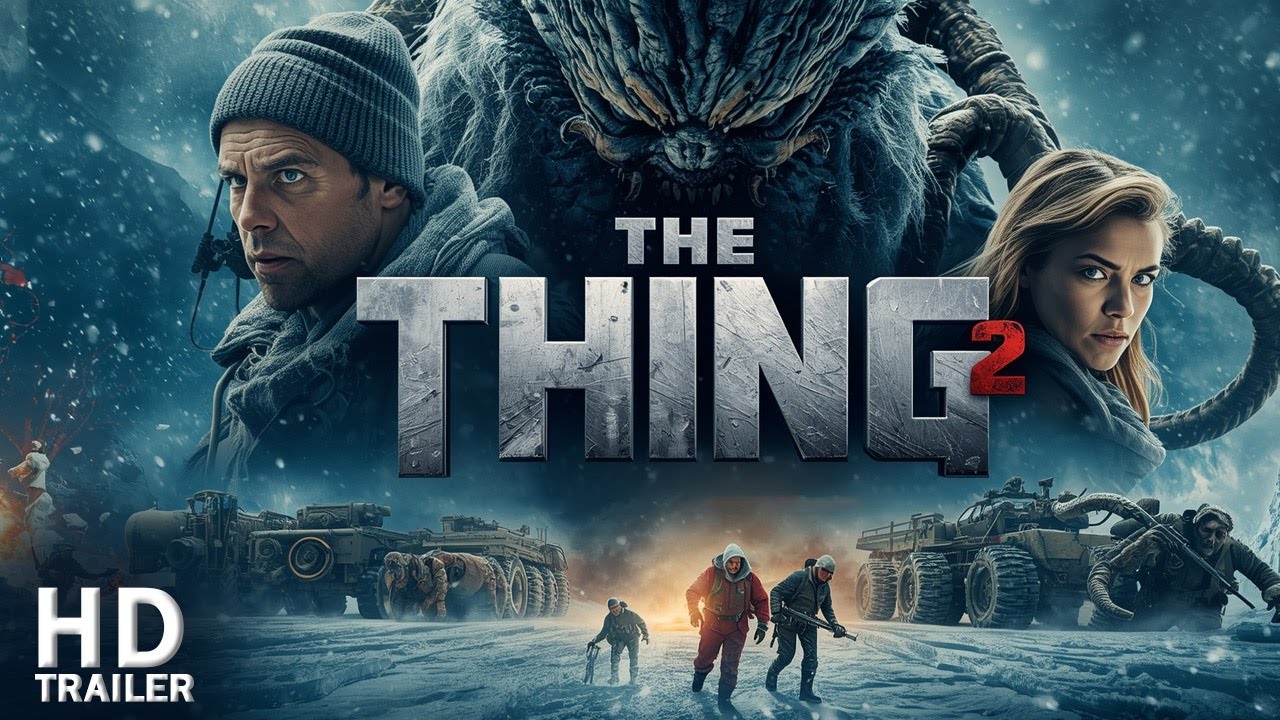
An Icy Legacy Reawakened
There are horror films that scare us, and then there are horror films that infect us. John Carpenter’s The Thing belongs firmly in the latter category, a movie that seeps into the imagination and refuses to thaw. The Thing 2 (2026) arrives not as a nostalgic retread, but as a continuation that understands the most terrifying aspect of its predecessor was never the creature itself. It was the creeping certainty that trust is a liability.

Decades after the Antarctic disaster, the shape-shifting alien has not only survived, it has adapted. That idea becomes the film’s thesis: evil does not repeat itself exactly. It learns. It improves. And sometimes, it hides in plain sight.

Story and Themes: Horror Rooted in Human Nature
The film follows a new research and rescue team responding to what initially appears to be a routine operation. The setting expands beyond the ice, but the emotional climate remains glacial. Paranoia spreads faster than the organism itself, turning colleagues into suspects and cooperation into a dangerous gamble.

What elevates The Thing 2 is its patience. The screenplay understands that horror is most effective when it allows silence to breathe. Conversations are clipped. Glances linger too long. Every interaction carries an unspoken subtext: Are you still human?
Like the original, the film uses science fiction as a mirror for social anxiety. In an era defined by misinformation, fractured communities, and fear of infiltration, the story lands with uncomfortable relevance. The monster is horrifying, but the breakdown of human trust is the true apocalypse.
Performances: Controlled, Intelligent, and Grounded
Mary Elizabeth Winstead anchors the film with a performance built on restraint. She plays intelligence not as bravado, but as exhaustion sharpened by necessity. John Boyega brings a simmering intensity, projecting both moral certainty and creeping doubt as the situation deteriorates. Their dynamic becomes the emotional backbone of the story.
Jeffrey Wright and Giancarlo Esposito add gravitas, each embodying different responses to fear. One leans toward logic, the other toward control, and both approaches prove dangerously insufficient. A brief flashback cameo from Kurt Russell serves as a quiet echo rather than a gimmick, a reminder of how unresolved trauma lingers across generations.
Direction and Atmosphere: Tension Over Spectacle
Visually, The Thing 2 resists the temptation to modernize its horror with excess. The camera lingers. The edits cut late. Shadows are allowed to dominate the frame. This is a film confident enough to let the audience imagine what might be happening just outside the light.
The creature effects strike a careful balance between practical texture and digital enhancement. Transformations are shocking not because they are loud, but because they feel wrong, violating the physical rules we subconsciously trust. Each reveal lands like a betrayal.
Key Strengths
- Atmospheric tension that builds rather than rushes
- Strong ensemble performances grounded in realism
- Creature design that honors practical horror traditions
- Thematic relevance that extends beyond genre thrills
Honoring Carpenter Without Imitation
The greatest risk facing any sequel to a beloved classic is imitation masquerading as respect. The Thing 2 avoids this trap by understanding what made Carpenter’s film endure. It was not the gore alone, but the mood of existential dread, the sense that humanity itself might be obsolete.
Rather than recreating iconic scenes, the film echoes ideas. Blood tests become psychological trials. Locked doors are replaced by moral dead ends. The score nods subtly to the original’s minimalist menace without leaning on it as a crutch.
Final Verdict: A Worthy and Intelligent Sequel
The Thing 2 does not try to replace its predecessor, and that is precisely why it works. It recognizes that horror franchises survive not by escalating body counts, but by deepening their fears. This is a film that trusts its audience to feel uneasy, to sit with uncertainty, and to question every face on screen.
For longtime fans, it offers respect without reverence. For newcomers, it delivers a gripping, nerve-shredding experience that stands on its own. In a genre crowded with loud reboots and hollow nostalgia, The Thing 2 arrives as something rarer: a sequel that understands terror evolves, just like the monster at its center.
No one is safe. No one can be trusted. And horror, when done this well, still has the power to freeze us in our seats.