




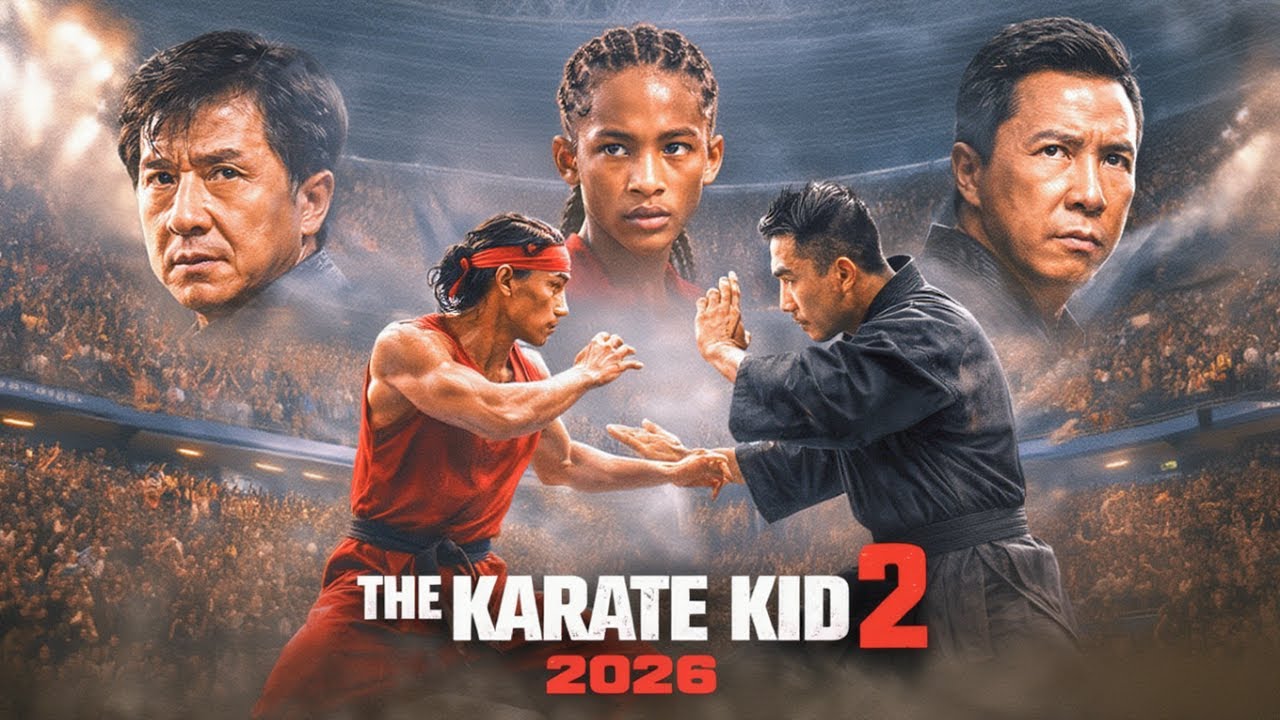
A Familiar Legend Reforged for a Restless Age
There are movie franchises that survive on nostalgia, and then there are those that understand why they mattered in the first place. The Karate Kid (2026) belongs firmly in the latter camp. Rather than merely dusting off a beloved title, this new chapter interrogates the meaning of discipline in a world that increasingly mistakes attention for achievement and force for strength.

After more than a decade of watching Hollywood recycle its past, I approach revivals with caution. Yet this film earns its right to exist by asking a timeless question with renewed urgency: when winning becomes everything, what happens to character?

Story and Themes: Fighting the Self
The narrative once again follows Dre Parker, portrayed with renewed maturity by Jaden Smith. This is not the wide-eyed student we met years ago. Dre is older, more capable, and burdened by expectations that stretch far beyond the dojo. Fame, pressure, and public scrutiny weigh on him, turning his journey inward. The true opponent is no longer the bully across the mat, but the ego within.

Mr. Han, played with serene gravitas by Jackie Chan, returns not as a man of many words, but as a moral anchor. His teachings feel less like instructions and more like quiet warnings. Each lesson suggests that skill without restraint is hollow, and ambition without humility is dangerous.
The screenplay wisely slows down when it matters most. Between the bruises and the sweat are moments of reflection that allow the philosophy of martial arts to breathe. The film understands that kung fu, at its core, is a way of thinking long before it is a way of fighting.
Performances: Old Wisdom, New Pressure
Jackie Chan as Mr. Han
Jackie Chan delivers one of his most restrained performances in years. Age has softened his movements but sharpened his presence. Mr. Han feels like a man who has already fought his greatest battles and now measures success by what he prevents rather than what he conquers.
Jaden Smith as Dre Parker
Jaden Smith surprises with emotional control and physical confidence. His performance reflects growth, both personal and professional. Dre is flawed, impatient, and occasionally arrogant, but that complexity makes his arc compelling. The film trusts Smith to carry its emotional weight, and he largely succeeds.
Cristiano Ronaldo: A Symbol, Not a Gimmick
Cristiano Ronaldo’s presence could have been a distraction, but the film uses him symbolically rather than sensationally. He represents the seductive pull of global fame and peak performance culture, a mirror to Dre’s internal conflict. It is a clever casting choice that reinforces the film’s central themes without overwhelming them.
Direction and Visual Language
The direction favors clarity over chaos. Training sequences are shot with patience, allowing the audience to feel the repetition, the fatigue, and the discipline required to improve. When the action escalates, it does so with purpose. Each strike feels intentional, each confrontation earned.
Visually, the film contrasts noisy public spaces with the quiet discipline of training environments. This visual tension mirrors Dre’s struggle between external validation and inner balance. The camera often lingers just long enough to let a moment settle, a choice that recalls a more classical approach to storytelling.
Music and Sound: Silence as a Teacher
The score knows when to step back. Instead of constant musical cues, the film often relies on ambient sound and silence. Breathing, footsteps, and the echo of a strike against wood become part of the rhythm. It is an understated choice that reinforces the meditative aspects of martial arts.
What Works Best
- A thoughtful exploration of discipline versus ego
- Jackie Chan’s quietly powerful performance
- Action scenes that serve character rather than spectacle
- A mature evolution of Dre’s character
Where It Stumbles
- Some supporting characters feel underdeveloped
- The pacing briefly slows in the middle act
- A few thematic ideas could have been pushed further
Final Verdict
The Karate Kid (2026) does not chase trends or overwhelm its audience with noise. Instead, it listens. It listens to the philosophy that made the original story endure and adapts it for a generation navigating pressure, fame, and identity.
This is a film that understands greatness is not defined by trophies or applause, but by restraint, humility, and self-knowledge. Like its best lessons, it lingers after the final frame, inviting reflection rather than applause.
In a cinematic landscape obsessed with louder, faster, and bigger, The Karate Kid (2026) reminds us that discipline, when practiced with sincerity, is still a form of quiet rebellion.